
Construction projects generate an immense amount of data, but merely creating data is just the beginning. Properly organising, managing, distributing, and analysing this data is essential for running a project efficiently. However, achieving this can be a daunting task, especially when dealing with diverse project teams from different companies, each with their own unique approaches. These stakeholders often rely on various software tools, resulting in fragmented workflows and unreliable data.
The Power of a Common Data Environment (CDE)
Imagine having a single platform that brings together all your project workflows. A place where reliable data is stored and accessible to the entire project team. Enter the Common Data Environment (CDE). As architecture, engineering, and construction (AEC) teams strive for greater project management efficiency and improved outcomes, the CDE emerges as a powerful solution.
What Exactly Is a Common Data Environment?
A Common Data Environment (CDE) serves as a digital information hub. It centralises project data storage and access, primarily related to construction projects and Building Information Modelling (BIM) workflows. Initially, CDEs focused on BIM data and information, but today they encompass a broader range of documents. These include project contracts, estimates, reports, material specifications, and other critical information relevant to a project’s design and construction processes.
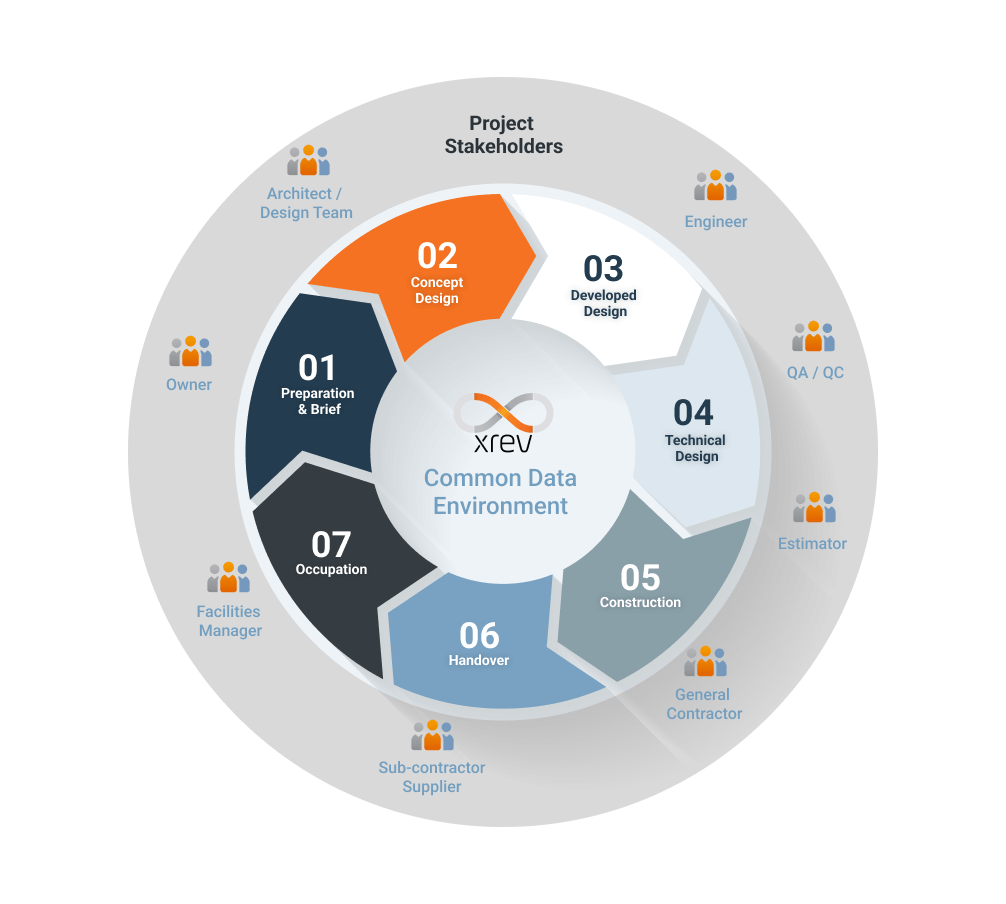
Figure 1. A Common Data Environment (CDE) as a centralised data management hub across the entire project lifecycle for all stakeholders to communicate.
How Does a CDE Work?
- Inclusive Repository:
A CDE acts as an inclusive repository for data generated throughout a project’s lifecycle—from design and construction to operation. It consolidates information from various disciplines and stakeholders. - Universal Access:
Project stakeholders, whether architects, engineers, contractors, developers, owners, or field workers, can access the CDE anytime and anywhere. Whether on a computer, mobile phone, or tablet, the CDE ensures seamless collaboration.
Why are CDEs Essential?
- Streamlined Workflows:
By centralising data, CDEs eliminate silos and fragmented workflows. Everyone works from the same reliable information, reducing errors and delays. - Any Project:
Particularly useful for large-scale construction projects which involve many stakeholders. CDEs facilitate smooth communication, data exchange, and coordination among diverse teams for projects of any scale. - Any Stage:
The implementation of a CDE at the initial stages of a project lifecycle yields more comprehensive project records and amplifies the value the CDE brings to the construction process. - Real-time Project Data:
Real-time project data empowers project teams to make informed decisions, respond swiftly to challenges, and deliver successful outcomes.
What are the Benefits of a CDE?
- Centralised Data Management:
A CDE serves as a digital hub where all project documentation and information converge. It provides a single repository for project documents, drawings, and files. Stakeholders from different disciplines—engineers, architects, contractors—can collaborate more effectively by accessing the same centralised data. Streamlined access ensures that everyone works from the most up-to-date information, reducing delays, preventing errors and conflicts arising from outdated or conflicting data, and enhancing transparency. - Cost Reduction and Accuracy:
By using a CDE, stakeholders can reduce costs associated with document storage and retrieval. It eliminates the need for physical storage spaces and minimizes administrative overhead. Decision-making accuracy improves as stakeholders rely on consistent, reliable data stored within the CDE. - Efficient Workflows:
CDEs streamline processes such as document management, version control, and audit trails. They facilitate efficient communication and coordination among project teams, reducing delays and enhancing overall productivity. - Compliance and Transparency:
CDEs ensure compliance with governmental regulations and industry standards. By maintaining an audit trail of built assets, CDEs enhance transparency and accountability. - Timely Insights:
Access to a CDE provides up-to-the-minute information on project progress and potential issues. This allows project managers and stakeholders to make informed decisions promptly. - Improved Communication:
A CDE fosters better communication among team members, contractors, and clients. Everyone has access to the same information, reducing misunderstandings and streamlining collaboration. - Accurate Tracking:
Tracking of tasks and due dates ensures that the project stays on schedule. Any deviations can be addressed promptly, minimising delays. - Risk Mitigation:
Early detection of risks or deviations from the plan allows for proactive risk management. A CDE helps minimise the use of outdated or conflicting data, reducing the chance of errors, miscommunication and delays, identify potential bottlenecks, ensure safety concerns, or budget overruns, teams can work remotely without compromising data security. - Quality Assurance:
CDEs offer ongoing quality monitoring. Approval workflows guarantee that project information undergoes thorough review in the appropriate context for its intended purpose. Every coordination activity, design modification, and associated cost and time implications, along with their respective statuses, are meticulously documented to prevent any loss or oversight of information. - Adaptability:
Projects often encounter unexpected changes. A CDE and its access to real-time data enables agility—teams can adjust plans, schedules, and resources based on real-world conditions. - Access Control and Security Measures:
Robust access controls and security measures in CDEs protect sensitive project information, meeting the regulatory compliance standards set by ISO 19650.
ISO 19650 Requirements of a CDE
ISO 19650, a set of standards, plays a pivotal role in defining the expectations for a CDE. ISO 19650 defines not only the requirements but also the framework for effective collaborative information management throughout a built asset’s lifecycle using BIM.
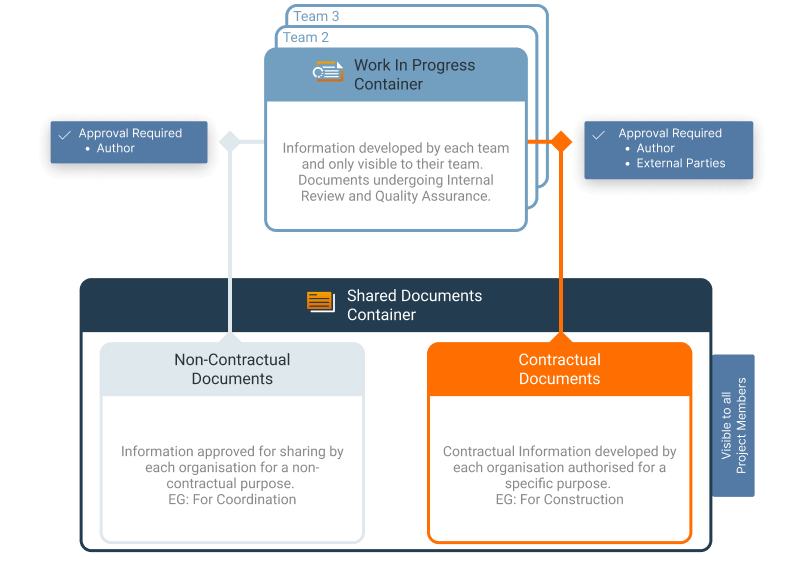
Figure 2. Xrev™ application of ISO 19650-1 Figure 10 – Common data environment (CDE) concept. Archive is not shown as in a CDE archived information remains in the container it reached with its status changed.
- Unique Identifiers and Standard Naming:
Each “information container” or document must have a unique identifier. Standard naming conventions ensure consistency. - Suitability Status Assignment:
All data receives a “suitability status” indicating its authorised purpose of use. - Version Control:
Past revisions should not be actively used to prevent confusion. - Controlled Information Flow:
Documents must follow a review workflow through the various containers for Work in Progress, Shared, Published and Archived states. This requires an individual must approve a document revisions suitability for a purpose in order to traverse between states. - Audit Trail Implementation:
Tracking changes ensures transparency and accountability.
Dispelling Misconceptions
- CDEs Are Only for Large Projects:
While CDEs can benefit large projects significantly, their principles are scalable and applicable to projects of all sizes. - CDEs Are Only for Contractors / Builders:
Numerous CDEs concentrate solely on the later stages of the design or construction phase, typically after the contractor’s involvement begins. Such CDEs often exhibit complexity, featuring numerous functionalities centered around Contract Administration and Field integration. Unfortunately, this complexity may compromise user-friendliness for many individuals. However, contrary to this trend, CDEs like Xrev™ are challenging the norm by creating tools that enable accessibility to CDEs at much earlier stages in the project lifecycle. - Implementation is Complex and Time-Consuming:
Implementing a CDE doesn’t have to be overly complex. With proper planning and the right tools, organisations can seamlessly integrate a CDE into their project management processes. Not all CDEs are created equal, Xrev™ is extremely simple to get started. Getting started can be as simple as logging in and selecting Create Project. - Publishing information is tedious:
Uploading extensive project files into certain CDEs can indeed pose a challenge. Many CDEs come with mandatory fields that require manual input. However, solutions like Xrev™ tackle this issue by integrating with BIM authoring tools. This integration enables the automatic population of essential metadata or employs intelligent extraction methods from file names, ensuring a smooth and seamless process. - CDEs Are Expensive:
Indeed, while certain CDEs adopt a pricing structure based on a percentage of the project’s construction cost, it’s important to note that not all CDEs adhere to this model. There are more budget-friendly alternatives, like Xrev™ with pricing models based on users or project rates. Some of these options offer affordability comparable to simple file-sharing tools like Dropbox but provide significantly enhanced functionality.
What can I do with a CDE?
We trust that we’ve successfully highlighted the advantages and value that a CDE can offer to any construction project. Now, let’s delve into the practical functionalities that a CDE can provide in your everyday operations.
- Centralised Information Access:
Attempting to independently oversee and maintain localised copies of information from various stakeholders, distributed across numerous platforms, is a futile process. A centralised data repository, such as that offered by a CDE, empowers you to search, download, view, annotate, measure, and compare documents, drawings, models, and data seamlessly, eliminating the need for multiple tools or platforms. This ensures continuous access to the latest versions and facilitates comparisons between revisions, enabling well-informed decision-making. - Review, Approve and Reject Information:
Controlled workflows enable you to assess documents intended for sharing by your team or those issued by other stakeholders for contractual purposes. You can either approve or reject them, annotate changes, and allocate tasks to individuals, teams, or roles, ensuring comprehensive capture of all design instructions. - Create and Assign Tasks:
Whether it’s an RFI, Instruction, Coordination Issue, Change Order, or any type of action that needs attention, a CDE empowers you to generate tasks of different types and assign them to individuals and teams for resolution. Establish deadlines, attach tags, impacts, reference information, and comments; all relevant stakeholders will receive notifications at each update until the task is successfully completed and verified. - View and Compare Documents:
Access and view almost any document without the need for desktop software. Some CDE’s can even compare and highlight changes between versions, allowing stakeholders to add mark-ups where necessary, such as incomplete tasks from previous versions. - View all activity and receive notifications:
Monitor and review activity within a CDE, observing who took specific actions and when, with a comprehensive audit trail. Xrev™ offers the capability to visualise the project state at any given time (rewind to any selected date). Choose to receive email or in-app notifications regarding activities of interest, enabling you to stay informed about any new developments. - Access Information from Anywhere:
Through a secure login, a CDE allows access to the project from any device with internet access.
-
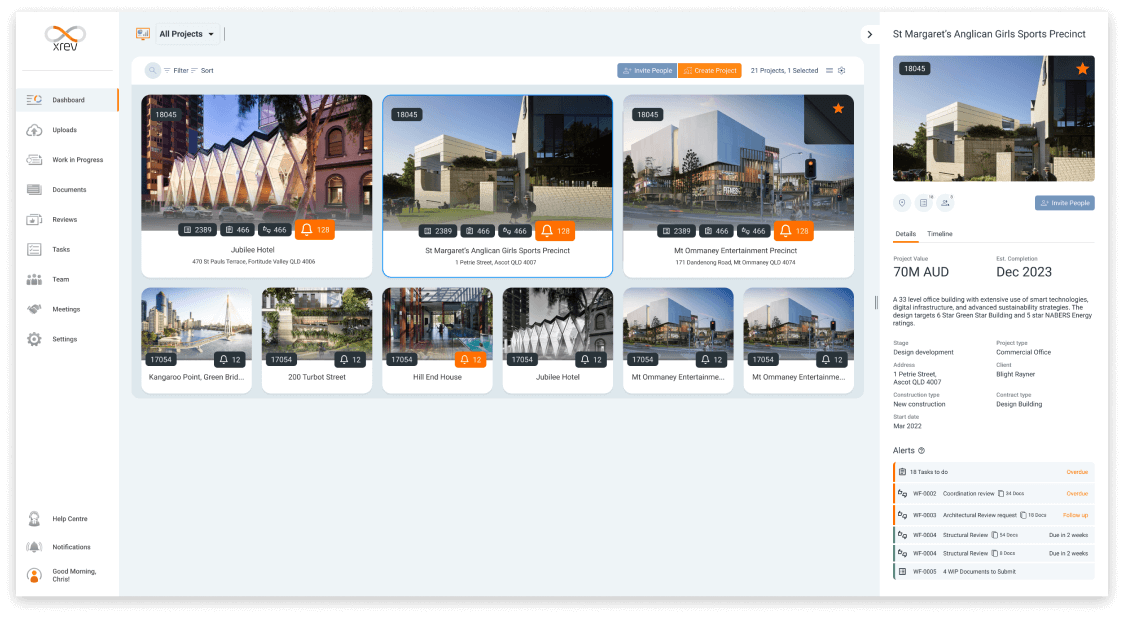
- Figure 3. Xrev™ Projects Dashboard
CDE Platforms
The construction industry offers numerous cloud-based common data environment platforms, each catering to diverse market sectors and fulfilling specific project team objectives.
Xrev™
Xrev™ offers an optimised feature set tailored for project collaboration right from the initial sketches of a project. Unlike most platforms, Xrev™ is specifically designed and priced for use before contractor engagement, but equally benefits all project sizes and phases. In the AECO industry, discussions and collaborations revolve around designs, conveyed through sketches, drawings, visualisations, models, and specifications.
The challenge with communication over email or phone is the need to reference specific documents. Emails may contain numerous references, making it difficult to track and follow conversations or design instructions. Xrev™ addresses this by adopting a highly flexible and interconnected web, where all communication is directly linked to documents, tasks, meetings, and reviews. This ensures that regardless of where you’re looking, you can access all related information within seconds.
With Xrev™, say goodbye to the risk of losing project information and experience seamless collaboration throughout your project lifecycle!
Xrev™ stands out as one of the few solutions that effectively addresses the quality assurance requirements of ISO19650 through its Work In Progress container. This dedicated space serves as a private area for your organisation to facilitate internal collaboration. You can publish Work In Progress documents within this container, enabling your team to access current drawings without the need for additional software licenses. Team members can efficiently complete markups, engage in discussions, and conduct thorough reviews of each document before final approval for sharing with the broader project team beyond your organisation. Xrev™ ensures a streamlined and secure process for managing your work in progress, aligning with ISO19650 standards.
Explore a multitude of additional features and begin utilising Xrev™ today—completely free!
- Extremely easy to use
- Search and find information in seconds
- View and Mark-up 40+ file formats
- Reviews / Approvals
- Task Management
- Meeting Management
- Subscriptions (Notifications with Noise Cancelling)
- Sync with construction phase CDE’s
As industries traverse the digital frontier, the implementation of a Common Data Environment, as defined in ISO 19650, is not merely a choice but a necessity for successful and future-proofed project delivery. The structured information management, collaboration, version control, and security measures provided by a CDE align seamlessly with the principles outlined in ISO 19650. Dispelling misconceptions, organisations can recognise the scalability of CDEs and the streamlined benefits they bring to projects of all sizes. In summary, a well-implemented CDE acts as a digital linchpin, connecting stakeholders, minimising risks, and adding substantial value to the tapestry of contemporary project management.